
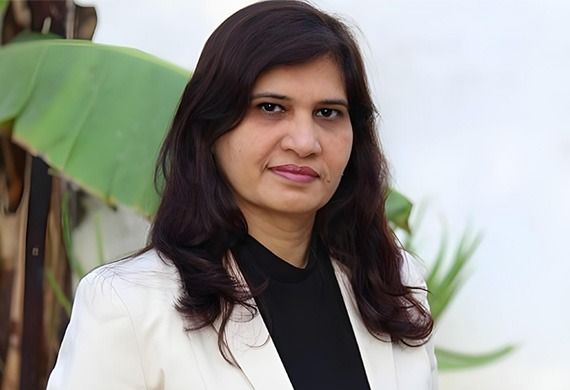

Technical innovation in safety-critical industries such as aerospace demands trust. Tech and engineering leader, Dr Seema Chopra, who holds over 25 AI patents in aerospace, believes that impactful breakthroughs come from translating complex concepts into deployable, trustworthy systems.
In an exclusive interaction with Women Entrepreneurs Review Magazine, Dr Seema shares her perspective on responsible AI in aerospace. She emphasizes that innovation must be grounded in deep technical rigor, accelerated capabilities, modular certifiable architectures, and strong cross-disciplinary collaboration. At the same time, she underscores that ethical principles such as safety-first engineering, stringent certification, transparency, and governance are essential to maintaining public trust.
Dr Seema is a globally recognized AI leader, with over two decades of cross-industry experience, known for her contributions to patents, research, and innovation, driving responsible AI adoption and advancing safety-critical engineering systems worldwide.
Read the following article for more insights on how to develop and deploy AI responsibly in safety-critical industries like aerospace while balancing innovation, engineering rigor, certification, and ethics.
Q) How did your journey across research, patents, and enterprise AI strategy shape a philosophy where technical depth and ethical accountability evolve together?
A) My journey across research, patents, and enterprise AI strategy has reinforced one core belief: technical innovation and ethical accountability must work together. In safety-critical industries such as aerospace, innovation carries the responsibility to ensure that systems are transparent, explainable and rigorously validated.
With more than 25 AI patents in aerospace, I have seen that breakthrough ideas alone are not enough. The real impact comes from translating complex concepts into deployable, trustworthy systems.
AI must not only be advanced but also trusted—by engineers, regulators and the global aviation community.
That trust is built when strong scientific foundations are paired with disciplined engineering practices and ethical design principles.
Q) As AI becomes integral to safety-critical aviation systems, how does responsible AI strategy balance breakthrough innovation, certification rigor, and long-term operational trust across global aerospace ecosystems?
A) A responsible Artificial Intelligence (AI) strategy begins by embedding verification, explainability, and traceability into the engineering lifecycle so that algorithms are evaluated with the same rigor as any other aerospace system. In aviation, AI cannot work as a “black box”; every decision must be interpretable and traceable to ensure accountability in safety-critical environments.
In practice, this often involves hybrid approaches that combine data-driven models with domain engineering expertise, enabling both high-performance and reliability. At Boeing, teams across global engineering hubs are advancing capabilities in predictive maintenance, airplane health management, and manufacturing analytics to detect anomalies earlier and support more informed operational decisions.
Equally important is certification discipline. AI systems must undergo extensive validation, simulation and regulatory review before deployment, particularly in onboard applications. When innovation is developed within structured engineering and certification frameworks, it strengthens safety, enhances reliability, and builds long-term trust across the global aviation ecosystem.
Q) As global AI programs span multiple cultures and regulatory landscapes, how can technical standards ensure consistency while still encouraging localized innovation and scientific exploration?
A) As AI programs expand across diverse cultural and regulatory environments, consistency begins with a common engineering framework grounded in safety, ethics, traceability and performance. These shared principles enable teams across geographies to build and validate systems with a unified standard of rigor.
As I embark on any AI-led initiative, I focus on establishing strong foundational elements – clear business objectives, the right infrastructure, committed sponsorship and high-performing teams—while maintaining a global framework for safety and quality.
Within that structure, teams are encouraged to experiment, supported by formal design reviews and gated development processes that guide solutions from concept to deployment.
This balance ensures that global consistency does not come at the expense of scientific exploration but rather enables it in a disciplined and scalable way.
Q) When AI transitions from laboratory prototypes to flight-ready engineering systems, what decision frameworks align research ambition, certification realities, and sustained product reliability?
A) In aerospace, every AI capability must first demonstrate effectiveness in controlled laboratory environments before progressing further. In my view, a critical early step is defining a robust data strategy—ensuring that data is accurate, representative, and aligned with real-world operating conditions.
My experience currently with Boeing and with the General Electric Company previously has shown that any transition to deployment necessitates many reviews and testing cycles and those systems should work as expected. I work in collaboration with engineering, design, and data analytics teams to assess not only performance but also long-term safety, maintainability, and reliability. Structured, gated development frameworks play a key role in aligning research ambition with certification requirements, enabling AI solutions to mature into flight-ready systems with confidence.
Q) In enterprises where AI defines future competitiveness, how can technical roadmaps integrate data science, domain physics, and systems engineering into one cohesive innovation narrative?
A) I view technical roadmaps as a combination of data science, domain physics, and systems engineering in enterprises where AI leads future competitiveness instead of a series of solitary endeavors. I sometime use hybrid models, as I firmly believe in a cross-functional strategy of combining physics-based knowledge and data driven models.
In the case of rich data, I develop AI models based on it, but I never leave out domain physics to enhance accuracy, interpretability, and reliability. This balancing is based on the problem, be it design, operation or predictive systems. I assemble cross-functional teams with diverse backgrounds in analytics, engineering, and domain expertise to develop combined solutions. Scalability and collaboration further can be leveraged by utilizing cloud-based platforms. I believe innovation lies in the fusion of these fields into a unified system that provides performance and real-world applicability.
LAST WORD: Advice for women shaping the future of AI in complex, safety-critical industries on build strategic influence, technical authority, and a lasting technological legacy.
For women aspiring to shape the future of AI in safety-critical industries, building strong technical depth is foundational. A solid grounding in mathematics, engineering principles, and physics creates the credibility needed to lead in complex environments.
At the same time, domain expertise is equally important. In engineering-driven industries, context defines the quality and trustworthiness of solutions. I have found that some of the most meaningful innovations emerge through collaboration across disciplines, where diverse expertise converges to solve real-world problems.
It is also important to remain confident in your knowledge, take calculated risks and commit to continuous learning.
Building strategic influence comes not only from technical excellence but from the ability to apply that expertise to solve meaningful challenges.
Programs that expand access to STEM education and aviation careers — such as the Boeing Sukanya Program, which aims to increase women’s participation in India’s aviation sector — are helping to inspire the next generation of women technologists.
So, stay curious, committed, and focus on creating technologies that deliver lasting impact for both industry and society.
Current Issue
Most Viewed
- 1 Talented Indian Female Actors Who Also Moonlight as Successful Producers
- 2 7 Indian Female Podcasters You Must Know About
- 3 7 Powerful Independent Indian Women Journalists Who are Voices of Change
- 4 Ruchikaa Kapoor Sheikh: The Creative Mind Behind Netflix India's Popular Shows
- 5 7 Most Influential Women Educators India has had over the Years
- 6 11 Breakthrough Female Faces Ruling the Indian OTT Platforms
- 7 8 Timeless Female Indian Classical Dancers & their Legacy
- 8 Women's Health Startup HerMD Closing Doors Amid Industry Challenges
- 9 Real Meets Reel: A List of 11 Indian Movies based on Real Women
- 10 Rasha Hassan: A Visionary Leader On A Mission To Transform Dubai's Real Estate Landscape
- 11 5 Indian Women-led IPOs You Must Know About
- 12 11 of the Most Iconic 21st Century Women to become "The First Indian Woman"
- 13 India's 7 Funniest Women Stand-Up Comics You Must Follow
- 14 Aparna Purohit : Leading India's Most Popular OTT Platforms
- 15 How Leaders Can Balance Risk & Innovation in Today's Banking Landscape
- 16 Dr. K. Shilpi Reddy: Sculpting Healthier Futures For The Next Generation With Reforms In Obstetrics Care
- 17 Sylvia Dcosta: A Visionary Business Leader Pushing The Limits And Setting High Professional Standards
- 18 Top 5 All-Rounder Women Cricketers of India
- 19 How Tata AIA is Empowering Women with Insurance That Understands Their Needs


