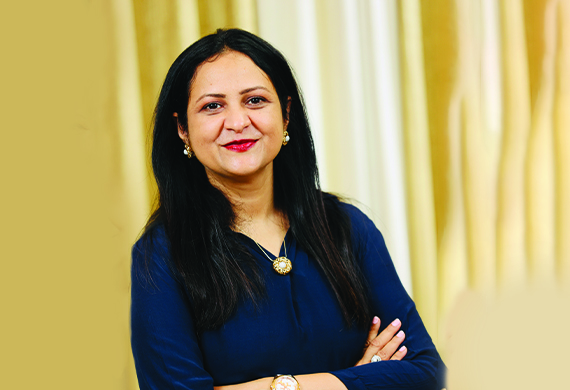

Swati brings to the table 20+ years of rich experience in research, analytics and consulting. Armed with a PhD (Economics) from Indian Institute of Technology (Delhi) and Masters in Business Economics (MBE) from Delhi University she has worked across industries including financial services, retail, healthcare, pharma and logistics.
In her current role at EXL she is the India Analytics leader for Retail Vertical and Select Banking Accounts.
In an interaction with Women Entrepreneur, Swati expounds on why enterprises are increasing investments in the development of technologies specifically analytics for customer acquisition, retention and enhancing operational efficiencies. She alsoopines onthe steps being taken for women inclusion in technology areas.
The Indian market has experienced considerable growth over the past several years. In your opinion, how big is the market opportunity for analytics and AI going forward?
The market opportunity for analytics and AI is immense. We are seeing growth in every aspect of the industry’s value chain, including in data engineering, reporting, predictive, prescriptive, and cognitive analytics. There is a lot of scope of application of analytics and AI across a variety of use cases in every industry, such as banking, retail, fintech, pharmaceutical, healthcare, insurance, travel, transportation, logistics, utilities, manufacturing and education. As per NASSCOM, AI adoption could add around 500 billion dollars to India’s economy by 2025. In terms of employee size, per NASSCOM’s latest India’s tech industry talent report, with the supply of AI and Big Data Analytics talent around 300-320K and demand around 430-450K, the demand-supply gap as a per cent of supply stood at around 50% in 2021. As per Analytics India magazine’s Analytics India Industry Study 2022, the Indian analytics industry recorded a substantial increase of 34.5% on a year-on-year basis in 2022, with the market value reaching USD 61.1 billion. There are an increasing number of initiatives, including Automation, ML ops, and AI as a Service, aimed at the democratisation of artificial intelligence and the creation of citizen data scientists.
Leveraging data for key business decisions is no longer a luxury but a necessity for organisations across the globe. What are some key advantages that companies can gain by making use of analytics for business?
If companies utilise analytics effectively, then at every point in decision-making, they can leverage the power of data to ensure further gains. An organisation’s primary goals are increasing revenue and profits, improving efficiency, and enhancing customer or employee satisfaction. Analytics can help achieve these goals across any of the functional areas marketing, risk and operations.
Companies can leverage descriptive analytics to see the business’s health, e.g., via campaign tracking, customer acquisition, engagement, churn and workforce productivity and utilisation reports. Diagnostic Analytics that help answer “Why”, can be leveraged to evaluate reasons for low performance, churn or lower employee satisfaction. Companies can predict customer lifetime value, fraud, or forecast workforce and machinery requirements using predictive analytics methodologies. Price optimisation, logistics/fulfilment optimisation, layout/product optimisation and implementation of a recommender system for personalised customer offerings are examples of prescriptive analytics. Additionally, video analytics to identify and prevent security breaches, image analytics for visual inspection, speech and text analytics for customer feedback and automated chatbots are examples of cognitive Analytics.
In a nutshell, by leveraging analytics across the value chain, organisations can enhance customer awareness, acquisition, engagement, retention and loyalty; minimise credit, fraud, market, operational, liquidity and reputation risk; and improve the efficiency of the front office and back office processes.
Tell us some interesting examples of the use of Analytics across various industries.
The power of data and analytics can be leveraged via exciting use cases across industries. Taking an example of a media industry - if we are watching television and an advertisement appears, then the normal reaction of the viewer is to switch channels. Suppose a company wants to ascertain that this does not happen and customers are retained on the channel. In that case, the company should implement a strategy to optimise ad break wherein the optimal start time of the ad break, optimal duration and the optimal frequency of ad breaks are determined by leveraging Analytics / Machine Learning/optimisation methodologies to ensure the overall customer retention and hence the revenue for the channelis maximised.
While this example highlights the use of predictive and prescriptive analytics, even descriptive and diagnostic analytics in terms of analysing reasons for revenue or spend leakage across BFSI or other industries can provide millions of dollars of benefit for the companies. Another interesting use case applicable across industries is providing an omnichannel experience to the customer by leveraging the combined power of online and offline data.
While the analytics examples vary in methodologies and approaches, one of the most critical steps is measuring the impact of analytics interventions at each step of the journey.
How do you foresee Analytics and AI transforming the way retail and banking businesses are running and will be run going forward?
AI is transforming banking and retail industries through various use cases across functions. According to industry reports, AI in both banking and retail are expected to grow more than 30% CAGR over the next few years.
In banking and retail sectors, Analytics use cases span across the entire gamut of prospect and existing customers, new product launches, strategy, and digital and regulatory compliance-related analytics. Marketing and optimising acquisitions include identifying prospects for the product, decisions around media mix or channel optimisation etc. Analytics across existing customers include digital journey personalisation, engagement, cross-sell, up-sell, attrition and retention analysis, spend analysis etc. Additionally, there are various collections, anomaly detection, fraud, risk and regulatory models specifically used in the banking industry.
In the retail sector, Analytics and AI bring autonomy to the operations by converting raw data from varied sources, including IoT, to foster customer and behavioural analytics leading to improved business outcomes. Some of the common benefits of AI in retail include better customer experience through optimised product placements, personalised emails or home pages, better customer service via chatbots, relevant recommendations, AI-enabled visual search engines, avoidance of long queues, better demand forecasting, inventory management as well as better pricing decisions. With the integration of online and offline data, which helps understand customer behaviour better, new applications, including better planograms, cashier-less checkouts, etc., are likely to be more widely adopted in future. Additionally, the increased use of automation, deep learning and natural language processing techniques will lead to further efficiencies and enhanced customer experience in the retail as well as banking industries going forward.
The inadequate representation of women in STEM roles has always been a point of concern. What is your take on this, and how do you witness the situation changing in the near future?
According to a UNESCO report, only 35% of STEM students in higher education are women; in India, 43% of STEM graduates are women; however, the proportion in the workforce is lower. As per the study of analytics India magazine in 2022, women constituted around 30 per cent of the analytics workforce in India.
With a lot of awareness being created and efforts from all sides, including parents, teachers, social organisations, and government, the situation is changing and likely to change further. There are so many initiatives at the country and global level; robust programs are being implemented to build a strong pipeline of women through early mentorship, recognition of women role models, reskilling and engaging STEM education, e.g., NASSCOM runs its Women Wizards Rule Tech initiative, which provides mentoring and training to women in various technology areas. A lot of emphases is given now from the school days; for example, my daughter and many of her friends, in grade 7 itself, are undergoing coding courses. Severalorganisations globally are driving initiatives for the development of women who code as well as training technology women for senior positions in leadership.
The situation is thus rapidly changing, and women who are keen to follow STEM areas willin future get ample opportunities, encouragement and empowerment to follow their passion.
Current Issue
Most Viewed
- 1 Talented Indian Female Actors Who Also Moonlight as Successful Producers
- 2 7 Indian Female Podcasters You Must Know About
- 3 7 Powerful Independent Indian Women Journalists Who are Voices of Change
- 4 Ruchikaa Kapoor Sheikh: The Creative Mind Behind Netflix India's Popular Shows
- 5 7 Most Influential Women Educators India has had over the Years
- 6 11 Breakthrough Female Faces Ruling the Indian OTT Platforms
- 7 8 Timeless Female Indian Classical Dancers & their Legacy
- 8 Women's Health Startup HerMD Closing Doors Amid Industry Challenges
- 9 Real Meets Reel: A List of 11 Indian Movies based on Real Women
- 10 Rasha Hassan: A Visionary Leader On A Mission To Transform Dubai's Real Estate Landscape
- 11 5 Indian Women-led IPOs You Must Know About
- 12 11 of the Most Iconic 21st Century Women to become "The First Indian Woman"
- 13 India's 7 Funniest Women Stand-Up Comics You Must Follow
- 14 Aparna Purohit : Leading India's Most Popular OTT Platforms
- 15 How Leaders Can Balance Risk & Innovation in Today's Banking Landscape
- 16 Dr. K. Shilpi Reddy: Sculpting Healthier Futures For The Next Generation With Reforms In Obstetrics Care
- 17 Sylvia Dcosta: A Visionary Business Leader Pushing The Limits And Setting High Professional Standards
- 18 Top 5 All-Rounder Women Cricketers of India
- 19 How Tata AIA is Empowering Women with Insurance That Understands Their Needs


