


History of Labor Day
May Day finds its origin in the United States, where workers struggled to reduce their working hours, which often stretched from 14 to 20 hours a day. Increasingly, the demand for a shorter workday was raised alongside demands for increased wages. As industrialization increased in the early 19th century, workers began organizing themselves into trade unions to demand humane conditions, and by 1837, under President Van Buren, a 10-hour workday was established for government workers. This 10-hour workday was, however, not universal, and the struggle to make it so continued for the next few decades.
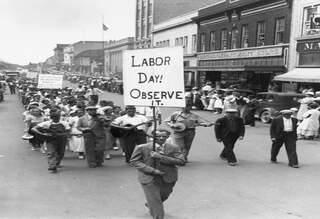 In the 1850s this demand gradually evolved into the more radical and widely embraced call for an eight-hour workday. The impact of this demand extended beyond the United States, as workers in Australia and other countries struggled for the same. In 1856 Australian stonemasons won an eight-hour workday. By the 1860s this demand gained influential backing when delegates from various trade unions gathered in Baltimore to form the National Labor Union in the United States. The NLU sought to unify workers across trades and passed a resolution at their inaugural meeting in 1866 that declared that the workday would be a maximum of eight hours across all states. The NLU eventually declined, but it laid the groundwork for a broader labor movement. That year the Geneva Congress of the First International endorsed the demand for an eight-hour workday.
The call for a shorter workday became only a small part of what May Day came to represent. The Federation of Organized Trades and Labor Unions of the United States and Canada (which later became the American Federation of Labor passed a resolution in 1884 declaring that from May 1, 1886, eight hours would constitute a legal day’s labor. This set a deadline and a nationwide call for action. The federation also called for an organized mass strike on May 1, 1886. The cause drew as many as 500,000 workers, including many unskilled and previously unorganized workers, involved in about 1,500 strikes. The movement became widespread across major cities in the United States, and was centered in Chicago, where the strike became especially hostile in Haymarket Square.
In 1889, the Second International, an international federation of socialist groups and trade unions, designated May 1 as a day in support of workers, in commemoration of the Haymarket Riot in Chicago (1886). Five years later, U.S. Pres. Grover Cleveland, uneasy with the socialist origins of Workers’ Day, signed legislation to make Labor Day—already held in some states on the first Monday of September—the official U.S. holiday in honor of workers. Canada followed suit not long afterward.
Who First Proposed the Holiday for Workers?
The answer is not entirely clear, but two workers can make a solid claim to the Founder of Labor Day title. Some records show that in 1882, Peter J. McGuire, general secretary of the Brotherhood of Carpenters and Joiners and a co-founder of the American Federation of Labor, suggested setting aside a day for a "general holiday for the laboring classes" to honor those "who from rude nature have delved and carved all the grandeur we behold."
But Peter McGuire's place in Labor Day history has not gone unchallenged. Many believe that machinist Matthew Maguire, not Peter McGuire, founded the holiday.
Recent research seems to support the contention that Matthew Maguire, later the secretary of Local 344 of the International Association of Machinists in Paterson, New Jersey, proposed the holiday in 1882 while serving as secretary of the Central Labor Union in New York.
According to the New Jersey Historical Society, after President Cleveland signed the law creating a national Labor Day, the Paterson Morning Call published an opinion piece stating that "the souvenir pen should go to Alderman Matthew Maguire of this city, who is the undisputed author of Labor Day as a holiday." Both Maguire and McGuire attended the country’s first Labor Day parade in New York City that year.
Current Issue

Most Viewed
- 1 Talented Indian Female Actors Who Also Moonlight as Successful Producers
- 2 7 Indian Female Podcasters You Must Know About
- 3 7 Powerful Independent Indian Women Journalists Who are Voices of Change
- 4 Ruchikaa Kapoor Sheikh: The Creative Mind Behind Netflix India's Popular Shows
- 5 7 Most Influential Women Educators India has had over the Years
- 6 11 Breakthrough Female Faces Ruling the Indian OTT Platforms
- 7 8 Timeless Female Indian Classical Dancers & their Legacy
- 8 Women's Health Startup HerMD Closing Doors Amid Industry Challenges
- 9 Real Meets Reel: A List of 11 Indian Movies based on Real Women
- 10 Rasha Hassan: A Visionary Leader On A Mission To Transform Dubai's Real Estate Landscape
- 11 5 Indian Women-led IPOs You Must Know About
- 12 11 of the Most Iconic 21st Century Women to become "The First Indian Woman"
- 13 India's 7 Funniest Women Stand-Up Comics You Must Follow
- 14 Aparna Purohit : Leading India's Most Popular OTT Platforms
- 15 How Leaders Can Balance Risk & Innovation in Today's Banking Landscape
- 16 Dr. K. Shilpi Reddy: Sculpting Healthier Futures For The Next Generation With Reforms In Obstetrics Care
- 17 Sylvia Dcosta: A Visionary Business Leader Pushing The Limits And Setting High Professional Standards
- 18 Top 5 All-Rounder Women Cricketers of India
- 19 How Tata AIA is Empowering Women with Insurance That Understands Their Needs

.jpg "Women's Reservation Bill Rejection, Debate & Reactions")

