
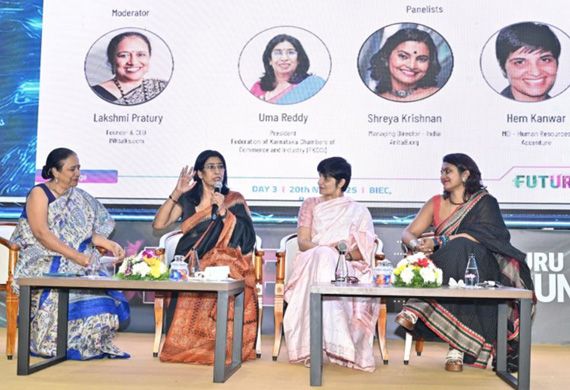

Bangalore Tech Summit’s third day featured a lively panel discussion featuring key women leaders, discussing ‘Designing the Future of Leader’. The panel, moderated by Lakshmi Pratury, Founder & CEO, INKtalks.com, explored in detail the evolution of leadership post-pandemic and the fresh challenges that contemporary organizations have to confront.
With debates on culture and the future of work getting more and more intense, the topic of modern leadership has been given a new depth of importance. The leadership way has to change just as fast as the surrounding world.
Changes in the labor market, technology becoming faster and the learning from the recent global disruptions are making people reconsider deeply what the real face of effective leadership is, nowadays.
The recently held Bengaluru Tech Summit 2025 hosted a lively discussion on ‘Designing the Future of Leadership’. It featured the three influential voices of the new work culture; Uma Reddy, President, FKCCI; Shreya Krishnan, Managing Director - India, AnitaB.org; and Hem Kanwar, MD – Human Resources, Accenture.
The panel, moderated by Lakshmi Pratury, Founder & CEO, INKtalks.com, explored in detail the evolution of leadership post-pandemic and the fresh challenges that contemporary organizations have to confront.
Pandemic as the New Leadership Timeline
The discussion initially centred on the pandemic being this generation's major point of reference, which will be remembered like the previously used historically significant events as landmarks for different times. The existence and the way people lead has been categorized into two distinct chapters i.e., pre-pandemic and post-pandemic.
Uma Reddy, a trailblazing entrepreneur and an authoritative figure in the industry, brought to the fore the radical change in human interactions and business models over the recent period of time. Before the pandemic, being physically present was an absolute must; after the pandemic, one can hardly find any leader or client who is not willing to work virtually with each other. “I still wonder how I had the time earlier,” she remarked, emphasising how technology has transformed efficiency, connectivity and expectations.
Human-Centred Leadership Takes Centre Stage
HR veteran Hem Kanwar underlined that leadership today demands a new vocabulary, one infused with compassion, trust, and empathy. The rapid shift to hybrid work dismantled the traditional command-and-control model, replacing it with a need for authenticity and resilience.
“Engagement and belonging are now central to performance,” she said. Leaders must cultivate informal connections in digital environments where such moments are rare.
Bringing the inclusion lens to the panel, Shreya Krishnan shared how the pandemic briefly boosted women’s workforce participation, only for numbers to drop sharply when offices reopened. She argued that leadership must reframe flexibility to genuinely include women and caregivers.
Shreya spoke passionately about the shifts she observes at the Grace Hopper Celebration India. Younger women are now more vocal, clear about what they want and even more importantly, what they don’t.
Sharing a moving anecdote from a scholarship programme, she emphasised how representation fuels ambition, “When I see all of you, I know I can also be there,” a young girl once told her.
Diversity as a Strategic Imperative
The panel strongly agreed that diversity is no longer a token checkbox but a strategic necessity for innovation. From gender and age to disability and global exposure, heterogeneous teams outperform homogeneous ones.
They said, leaders today, must become connectors, not commanders. Technology aids this transition, through communication, data flows and expanded reach but human empathy remains the core.
When asked what organisations must prioritise, Hem stressed on the importance of curiosity over rigid skills. As the changes in AI, digital tools as well as work structures are fast, the capability to learn is still the most valuable attribute of employees.
Besides, she warned that there is a possibility that AI systems may increase gender bias if they rely on past data. To prevent the uprising of unfairness, firms need to create recruitment and promotion instruments are oriented towards inclusiveness.
Collectives, Collaboration & the Power of Shared Support
The session closed with a lively conversation about building ecosystems, whether through chambers of commerce, women-in-tech collectives or national initiatives like AI Kiran, launched to educate and empower women in AI.
In true Lakshmi Pratury style, the closing remarks blended humour with insight, particularly her “war on sarees” initiative that turns wardrobe challenges into acts of community exchange. The light-hearted moment captured the spirit of the session.
A Call for Safer, More Inclusive Urban Spaces
During the audience interaction, a question about women’s mobility highlighted broader urban challenges. The panel pointed out that building safer infrastructure benefits all communities, women, men, disabled citizens, neurodivergent individuals, emphasising again that inclusion must guide every design for the future.
Current Issue

Most Viewed
- 1 Talented Indian Female Actors Who Also Moonlight as Successful Producers
- 2 7 Indian Female Podcasters You Must Know About
- 3 7 Powerful Independent Indian Women Journalists Who are Voices of Change
- 4 Ruchikaa Kapoor Sheikh: The Creative Mind Behind Netflix India's Popular Shows
- 5 7 Most Influential Women Educators India has had over the Years
- 6 11 Breakthrough Female Faces Ruling the Indian OTT Platforms
- 7 8 Timeless Female Indian Classical Dancers & their Legacy
- 8 Women's Health Startup HerMD Closing Doors Amid Industry Challenges
- 9 Real Meets Reel: A List of 11 Indian Movies based on Real Women
- 10 Rasha Hassan: A Visionary Leader On A Mission To Transform Dubai's Real Estate Landscape
- 11 5 Indian Women-led IPOs You Must Know About
- 12 11 of the Most Iconic 21st Century Women to become "The First Indian Woman"
- 13 India's 7 Funniest Women Stand-Up Comics You Must Follow
- 14 Aparna Purohit : Leading India's Most Popular OTT Platforms
- 15 How Leaders Can Balance Risk & Innovation in Today's Banking Landscape
- 16 Dr. K. Shilpi Reddy: Sculpting Healthier Futures For The Next Generation With Reforms In Obstetrics Care
- 17 Sylvia Dcosta: A Visionary Business Leader Pushing The Limits And Setting High Professional Standards
- 18 Top 5 All-Rounder Women Cricketers of India
- 19 How Tata AIA is Empowering Women with Insurance That Understands Their Needs


