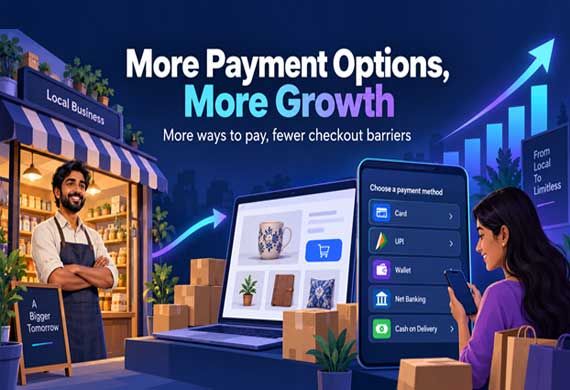

A customer adds something to their cart, gets to checkout, and leaves. Not because they didn't want the product. Because their preferred way to pay wasn't there.
It happens more often than most small business owners realise, and it rarely shows up as a clean data point. It just looks like abandoned carts, or a slightly lower conversion rate that nobody investigates too closely.
But if we go deeper into assessing the checkout behavior across small e-commerce and D2C businesses, a single pattern keeps surfacing, and that is that businesses growing revenue faster are not necessarily spending more on ads or discounts.
They are only giving their customers more options to pay and letting them pay the way they already want to, no questions asked. This is not a new checkout feature, but it's closer to a growth lever that most small businesses underuse.
Shifting Customer Preferences and Trends for Making Payments
Payment habits in India have changed faster than most businesses get the time to adjust and adapt. UPI is now the default for a large share of transactions, not the alternative.
Cards still matter, especially for higher-ticket purchases. Moreover, Cash on Delivery, while shrinking in some categories, hasn't disappeared; for a chunk of first-time online buyers, it's still the only option they trust.
What's changed is expectation, not just behaviour. Customers now assume their preferred method will be available, and when it isn’t available at all, they don't see it as a limitation of the store; it’s a friction point for them and a reason to abandon cart.
A few customer preferences worth noting here are;
- UPI has moved from "nice to have" to default payment method for most digital-first buyers.
- Credit and debit card usage remains strong for higher-value purchases and repeat customers, but only if the necessary protective measures are in place.
- COD still drives first-time trust in categories like fashion and home goods, allowing customers to first check the product’s quality before ordering again and this time with a different payment method.
- Buy-now-pay-later and wallets are growing among younger, mobile-first shoppers, especially for high-value goods.
Small businesses that treat this as a settled list, "we accept UPI and cards, and don’t need any more options", are often the ones quietly losing customers they never see again, and they never even see the friction that’s causing them to leave.
Key Drivers of Faster Revenue Growth
More payment options isn’t a secret recipe that will help you grow revenue automatically. What they do is remove a specific kind of leakage that's hard to spot until it's fixed.
Here's the thing: most small businesses measure marketing performance closely and look at metrics like;
- Cost per click
- Ad spend
- Conversion from landing page to cart
Rarely does any small business owner spend time on actually figuring out what’s happening between "add to cart" and "payment successful."
That's exactly where payment-related drop-off can be found.
A few drivers tend to show up consistently:
- Fewer Failed Transactions: A payment method that's slow, unfamiliar, or prone to declining transactions costs a sale even when the customer wants to buy.
- Trust at the Point of Decision: Seeing a familiar, expected payment option at checkout reassures a customer that the business is legitimate and their payment-related concerns are immediately addressed.
- Lower Cart Abandonment: Every extra step, redirect, or unfamiliar screen at checkout increases friction, as customers don’t want to provide any additional information or even divert from what they want to buy, and this increases the odds a customer just closes the tab.
- Repeat Purchase Behaviour: Customers who pay the first time smoothly are more likely to come back, because the experience didn't give them a reason to hesitate.
None of these is too big a reason for your customers to either abandon cart or make repeat purchases on their own. Stacked together, they add up to real revenue that was always achievable, just never captured.
Revenue Mechanics Small Business Owners Must Know Behind Payment Options
You need to consider adding more payment options less as a marketing decision and more as a structural decision. The revenue was always there in demand, but the question remains: how much of it actually reaches the business.
Every payment method a business adds effectively widens the funnel for your leads to become paying customers. Not because it brings in new customers by itself, but because it stops turning away customers who already wanted to buy.
A UPI-first customer who lands on a checkout page offering only card payments isn't going to create a new payment habit for one purchase and decide to leave.
This is why payment success rate matters as much as the number of options offered. Adding UPI is one thing, but ensuring UPI transactions actually go through smoothly, without timeouts or failed retries, is what determines whether that option translates into revenue or just sits there as a checkbox.
Faster refunds fit into this mechanic too, even though founders rarely connect the two. A customer who gets a refund quickly is far more likely to buy again as they begin to trust the brand. A customer stuck waiting, chasing support for a week, has built a negative image of the brand and is most likely not to buy from them again.
Why Do Payment Methods Matter More for Small Businesses?
Larger businesses can absorb the cost of a customer who leaves at checkout as they have a lot of other customers already completing their purchase. They have volume, brand recall, and repeat customers who will come back regardless. Small businesses don't have this luxury and cannot afford to lose even a single customer.
For a business still building its customer base, every abandoned checkout is disproportionately expensive. It's not just one lost sale; it's the ad spend or referral that got the customer there in the first place, gone with nothing to show for it.
There's also a trust gap small businesses have to build in a competitive market, which large businesses have already built and are today recognisable.
A new or lesser-known store already has to work harder to convince a customer to buy. Asking that same customer to also use an unfamiliar or restrictive payment method can take things overboard for the customers.
Offering a familiar option removes that friction at exactly the moment it matters most.
And for businesses selling internationally, or trying to, this becomes even more pronounced. A customer outside India isn't going to figure out a workaround for a checkout built only for domestic cards. If the payment options don't match how that customer actually pays, you have already lost the sale.
Choosing the Right Payment System for Small Businesses
The payment system a small business relies on matters far more than most founders realize. It’s tempting to treat it as a back-end decision, set once and forgotten but in reality, it’s a powerful growth lever. Choosing the best payment gateway for small businesses comes down to matching payment methods, settlement cycles, and collection flows to your actual business model.
A few things worth prioritizing when evaluating a payment gateway system are:
- Time to launch: How quickly can the business actually go live and start accepting payments?
- Payment method coverage: Does it support UPI, credit/debit cards, wallets, BNPL, COD, and international options?
- Transaction success rates: What does the actual success rate look like on the methods your customers use most?
- Refund experience: How are refunds handled, and how fast do they reach the customer?
- Global readiness: Can the setup support international buyers without requiring a separate stack?
This is where a platform like Cashfree comes up in founder conversations. Businesses often go live the same day they sign up, avoiding the lengthy onboarding delays typical of legacy gateways. Beyond fast setup, the checkout is optimized specifically for conversion success because a payment method that technically exists but fails frequently doesn't deliver real value. Additionally, for brands expanding overseas, collecting in 180+ currencies through a single, unified setup eliminates the friction of managing separate international integrations.
Ultimately, choosing a payment provider isn't about selecting the platform with the longest feature list. It’s about picking the solution that reliably captures maximum revenue at checkout without administrative overhead.
Conclusion
Small businesses spend a lot of energy trying to get customers to the checkout page. Far less energy goes into making sure that once they are at the checkout stage, they should not get any reason to abandon. That imbalance is where a meaningful amount of preventable revenue loss lives.
Adding more payment options isn't a growth hack, but it's about fixing a leak you never knew was already there until it starts to cost you money quietly.
The businesses that catch this early tend to grow faster, not because they found more customers, but because they stopped losing the ones they already had.
Current Issue
Most Viewed
- 1 Talented Indian Female Actors Who Also Moonlight as Successful Producers
- 2 7 Indian Female Podcasters You Must Know About
- 3 7 Powerful Independent Indian Women Journalists Who are Voices of Change
- 4 Ruchikaa Kapoor Sheikh: The Creative Mind Behind Netflix India's Popular Shows
- 5 7 Most Influential Women Educators India has had over the Years
- 6 11 Breakthrough Female Faces Ruling the Indian OTT Platforms
- 7 8 Timeless Female Indian Classical Dancers & their Legacy
- 8 Women's Health Startup HerMD Closing Doors Amid Industry Challenges
- 9 Real Meets Reel: A List of 11 Indian Movies based on Real Women
- 10 Rasha Hassan: A Visionary Leader On A Mission To Transform Dubai's Real Estate Landscape
- 11 5 Indian Women-led IPOs You Must Know About
- 12 11 of the Most Iconic 21st Century Women to become "The First Indian Woman"
- 13 India's 7 Funniest Women Stand-Up Comics You Must Follow
- 14 Aparna Purohit : Leading India's Most Popular OTT Platforms
- 15 How Leaders Can Balance Risk & Innovation in Today's Banking Landscape
- 16 Dr. K. Shilpi Reddy: Sculpting Healthier Futures For The Next Generation With Reforms In Obstetrics Care
- 17 Sylvia Dcosta: A Visionary Business Leader Pushing The Limits And Setting High Professional Standards
- 18 Top 5 All-Rounder Women Cricketers of India
- 19 How Tata AIA is Empowering Women with Insurance That Understands Their Needs


