
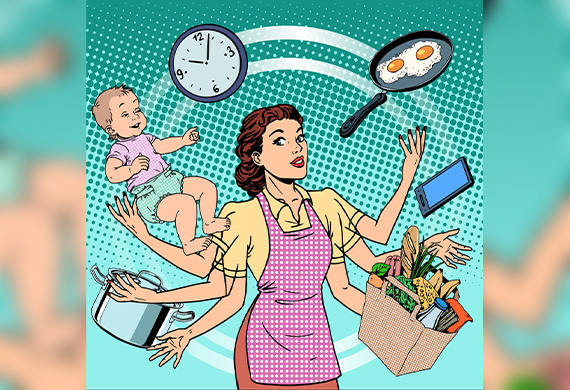

For a majority of women, taking care of the home and family is a full-time job. When paid labour and housekeeping are added together, young women who work wind up working longer hours each day and sleep much lesser finds out a report.
There has been much written on the fact that just roughly 1 in 5 Indian women of working age are employed. Arguments have been made concerning how the absence of acceptable occupations has a negative effect on women's decision to enter the workforce as well as gender norms surrounding marriage, parenting, and domestic duties.
It is rare that any one side can fully explain a complicated phenomenon like women's participation in paid work. However, the daily activities of young Indian women and how these activities evolve as a result of marriage and job can shed insight on limitations resulting from gender norms.
For example, by comprehending the degree of the trade-off between leisure and labour (both paid job and housekeeping), we can better understand why young women in India may choose not to enter or leave paid work, as has been seen in recent years, particularly in rural areas.
The survey took information at the individual level on daily time usage patterns from the 2019–20 nationally representative time use survey. Then, survey takes into account women in the 20–29 age range whose primary status activity is either domestic work or employment. Due to marriage and raising children, women tend to experience the biggest shift in the amount of time they spend on various activities around this age.
This is also the age when women seek to start their jobs and advance in their workplaces, especially in urban regions, due to the increased educational levels of women. Young women in education are not included because their daily activities are mostly focused on their studies.
Being married and working means less sleep and more work
For the majority of women, taking care of the home and family is a full-time job. Young women who work completely at home dedicate about 8 hours a day to household duties and caring for children and the elderly. It's possible that because they spread their labour out throughout the day, they report spending more time on cleaning than they actually do or need to.But it's safe to say that it takes up around a third of their day.
When paid labour and housekeeping are added together, young women who work wind up working 1.5 hours longer each day—9.5 hours total. They labour for pay for an average of five hours and fifteen minutes, and they do housekeeping for just over four hours. The overall workload for young women who are employed increases since the amount of time spent on housework does not diminish sufficiently to make up for the time spent working for pay.
When young women are grouped according to their marital status and their daily time spent working (paid labour plus housework) is compared, it rises to 10 hours for those who are married and working.
Their work schedule also changes in favour of housework; they spend 30 minutes less on paid work overall, working an average of 4 hours, 45 minutes per day out of a possible 10 hours.
Those who are unmarried and working, however, only spend 1.5 hours on housework and close to 6 hours, 40 minutes on paid labour. As a result, for young women who are working, the time spent on housekeeping increases from 1.5 hours to almost 5 hours and 20 minutes per day as a result of marriage and childcare duties.
Due to the dual pressure of paid job and household chores, young married employed women limit the amount of time they spend on leisure, sleep, self-care, and maintenance, as well as on activities related to community participation.
All of the foregoing groups of activities account for the smallest amount of these women's daily time. In contrast to married women who do not work for pay, they spend less time on leisure activities—barely 1 hour and 20 minutes—and less time on self-care and sleep—45 minutes less—than married women who do not work at home.
Increasing the number of female workers
It is hardly surprising that few women are able to balance this trade-off and maintain a full-time job after marriage.
While a lower percentage of young women in paid employment may have something to do with the lack of suitable jobs, the fact that marriage drastically changes the pattern of housework for women indicates that working full-time after marriage makes it difficult for women to manage daily life on a physical and mental level.
It is unlikely that many young married women in India will take up jobs and keep them for extended periods of time unless the responsibility of household duties is distributed more fairly among family members or can be outsourced.
Alternatively, if India wants a bigger percentage of young women to take up paid job, if they wish to, the conventions surrounding marriage, which are universally accepted in the country, especially by a certain age, need to undergo a considerable transformation.
Current Issue

Most Viewed
- 1 Talented Indian Female Actors Who Also Moonlight as Successful Producers
- 2 7 Indian Female Podcasters You Must Know About
- 3 7 Powerful Independent Indian Women Journalists Who are Voices of Change
- 4 Ruchikaa Kapoor Sheikh: The Creative Mind Behind Netflix India's Popular Shows
- 5 7 Most Influential Women Educators India has had over the Years
- 6 11 Breakthrough Female Faces Ruling the Indian OTT Platforms
- 7 8 Timeless Female Indian Classical Dancers & their Legacy
- 8 Women's Health Startup HerMD Closing Doors Amid Industry Challenges
- 9 Real Meets Reel: A List of 11 Indian Movies based on Real Women
- 10 Rasha Hassan: A Visionary Leader On A Mission To Transform Dubai's Real Estate Landscape
- 11 5 Indian Women-led IPOs You Must Know About
- 12 11 of the Most Iconic 21st Century Women to become "The First Indian Woman"
- 13 India's 7 Funniest Women Stand-Up Comics You Must Follow
- 14 Aparna Purohit : Leading India's Most Popular OTT Platforms
- 15 How Leaders Can Balance Risk & Innovation in Today's Banking Landscape
- 16 Dr. K. Shilpi Reddy: Sculpting Healthier Futures For The Next Generation With Reforms In Obstetrics Care
- 17 Sylvia Dcosta: A Visionary Business Leader Pushing The Limits And Setting High Professional Standards
- 18 Top 5 All-Rounder Women Cricketers of India
- 19 How Tata AIA is Empowering Women with Insurance That Understands Their Needs


