
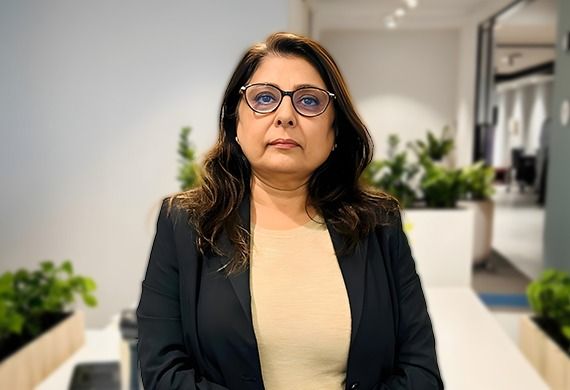

Leadership today goes far beyond authority and execution—it centers on building purpose-driven cultures rooted in empathy, ethics, and governance, believes Dolly Grover, a seasoned Human Resources leader with over three decades of experience across Telecom, Food & Beverage, and IT sectors.
In conversation with Women Entrepreneurs Review Magazine, Dolly highlights leadership’s shift to inclusive, people-centric models, emphasizing purpose alignment, ethical growth, and governance while underscoring authenticity, transparency, and trust as essential to building resilient, future-ready organizations.
With rich experience in HR transformation, ESG, sustainability, CSR, and DEI, Dolly has played a pivotal role in shaping organizations that are agile, inclusive, and aligned with a larger purpose—where success is defined not just by outcomes, but by intent and impact.
To learn more about her insights on leadership and building purpose-driven organizations, read the full article below.
Over three decades, the fundamentals of leadership have evolved drastically. How have you seen the concept of leadership transform from when you began your career to where it stands today?
Over the last three decades, corporate leadership has undergone a sea of changes. At the beginning of my career the leadership was more operational. It was very transactional with more direct approach to tasks and closure at hand. There was a heavy emphasis on protocols and hierarchy, it was difficult to approach top boss directly. With the business environment becoming more global, volatile, more technologically advanced, and to accommodate the disruptions of the Covid 19 pandemic, the leadership had to be adaptive with a changing pace where in the focus shifted from viewing productivity in isolation to ensuring that the employee feels a sense of belongingness through fostering meaningful connections, providing holistic employee experience, focus on wellbeing and care which will be primary drivers for organization success.
The leaders, now, are more receptive to fostering a meaningful environment where employees feel a sense of belongingness, as well as being more empowering towards the employees. Even new age technology has eased the way of working for leaders with instant real time gratification in work which was quite tough earlier with no such connectivity. To my mind, change has been for better and leadership transformation over the decades has ensured a better connect leading to an engaged environment leading to organization delivery.
In leadership, alignment between values and vision often defines credibility. How do you ensure that your decisions reflect empathy and strategic clarity?
To my mind, leadership decisions need to reflect the larger purpose of the organization, the ability to rally around a common purpose and to communicate clearly and effectively, that is all about being consistent in intent and action! “Walk the Talk” becomes the key ingredient which stamps the leadership credibility as people can see that decisions are grounded in both values and vision.
Being a part of the leadership team when I take decisions, the driving force is the common purpose; however, the impact of decision on people needs to be accounted for. It’s about the input which comes from hearing different perspectives from the teams and understanding the concerns raised, which helps in making an informed decision basis a particular context. To my mind, empathy is all about knowing the input which shapes the “how” of the decisions and strategy shapes the “why” of the decision. Both go hand in hand when a decision is made, and being transparent and connecting with teams on the rationale behind the decision helps teams stay aligned with the organization’s larger goals. It’s this fine balance which helps yield effective leadership and sustainable results.Top of FormBottom of Form
Being a woman leader who is involved in corporate governance and ESG, what have you learned regarding the act of striking a balance between ethics and enterprise growth when making real-world leadership decisions?
As a woman leader, my learning is that ethics and enterprise growth are not trade-offs however they are mutually reinforcing. Finalizing decisions is never an easy feat, though in my experience, the most sustainable growth comes from decisions that are rooted in strong governance, fairness, and transparency.
Strong Corporate governance forms the backbone of leadership decisions, providing the structure and discipline needed to balance ethical responsibility with enterprise growth.
It has helped me navigate difficult decisions by providing clarity on clearly defined non-negotiables. Staying grounded in values has helped me drive growth that is resilient, credible, and aligned with the organization’s larger purpose. It also helps if the leadership team is aligned with corporate governance and each employee is aware of the same. I have dealt with a situation where a call needed to be taken on the Business Head who was part of the top talent. Since our organization Governance model was strong with Ethics Committee in place, the decision was executed swiftly. It also led to being an example that we are walking the talk and are consistent in our approach irrespective of levels. The team reporting to the Business Head stepped up to ensure that the ball doesn’t drop and organization delivered on its goals.
In addition to the policies and structures, how do you bring those ethical and governance principles to life in everyday decisions across teams and leaders?
The policies and structures form a part of governance framework and the foundation of ‘Way of Working’ in the organization. The governance awareness cascades are a must to ensure that each member is aware of what it stands for in our organization, including the non-negotiables. In my experience,
the ethical and governance principles truly come alive through everyday leadership behaviour.
Its all about leading by example and once people start to see these principles applied consistently in real situations, they stop being rules on paper and start becoming part of how we work every day.
With this idea at the core and encouraging the leaders to speak up and share their perspectives on values, governance and so on in open forums like town hall helps cement the thought process across the organization and everyone takes cognizance of this. This is applicable to each function as well. For example in our organization, our processes catered to the ethics and governance that it became the way of working – all our contracts with vendor, employees, third party had addition of ABC clause (Anti Bribery and Corruption) , background verification was put in place for all positions and we had exits of new joinees basis non satisfactory checks. With such everyday decisions, ethics and governance form part of the culture rather than just a framework.
Over the years, how has your idea of success evolved – from early career milestones to today's formation of large-scale purpose-driven organizations?
There has been a mammoth change in the thought process from when I started my career to now. Starting of my career involved learning assimilation, execution of key agreed deliverables, ensuring the tasks at hand get done with a double tick, getting into thick and thin of everything that needs to be done. It was all about doing my best, to take more responsibility and be empowered to support the team and leadership. Each role transition broadened my perspective, reshaped my decision-making approach, and accelerated my shift from an individual contributor to a leader balancing both strategy and execution. There has been a humongous transition on the kind of maturity and thought process which came with each role change, mainly a result of my experience and exposure across industries and organizations.
Today being a part of the leadership team and supporting the businesses from the Group office, the success accounts for building the organization which is driven, agile and shares the common purpose. It’s all about creating a clear sense of purpose with transparency and trust, resulting in organization that is growing responsibly, where people feel valued and are the brand ambassadors, where the impact goes beyond number and, focus is more on the input and the intent resulting in the growth which is meaningful and lasting.
For the next generation of women leaders who will step into values-driven roles, what principle would you like them to carry forward as they define their own leadership path?
For the next generation of women leaders stepping into the values-driven roles, the principle I would like them to carry forward is leading with authenticity, strong governance and people connect. In this world of technology and AI, where the digitization has become ever present leaving a very little window for human interaction, one need to have clarity on being grounded in integrity and ethics, which shapes one’s choices erring on the right side of caution. Being true to oneself leads to a one’s credibility which goes a long way in building trust.
Each person’s journey is different and each one of us will have varied exposure which will shape the value you bring to the table and your own unique value proposition helps define your own leadership path, which is more resilient, inclusive and purposeful in delivering on the larger picture, creating impact not only for oneself, but also for the teams at large.
Current Issue
Most Viewed
- 1 Talented Indian Female Actors Who Also Moonlight as Successful Producers
- 2 7 Indian Female Podcasters You Must Know About
- 3 7 Powerful Independent Indian Women Journalists Who are Voices of Change
- 4 Ruchikaa Kapoor Sheikh: The Creative Mind Behind Netflix India's Popular Shows
- 5 7 Most Influential Women Educators India has had over the Years
- 6 11 Breakthrough Female Faces Ruling the Indian OTT Platforms
- 7 8 Timeless Female Indian Classical Dancers & their Legacy
- 8 Women's Health Startup HerMD Closing Doors Amid Industry Challenges
- 9 Real Meets Reel: A List of 11 Indian Movies based on Real Women
- 10 Rasha Hassan: A Visionary Leader On A Mission To Transform Dubai's Real Estate Landscape
- 11 5 Indian Women-led IPOs You Must Know About
- 12 11 of the Most Iconic 21st Century Women to become "The First Indian Woman"
- 13 India's 7 Funniest Women Stand-Up Comics You Must Follow
- 14 Aparna Purohit : Leading India's Most Popular OTT Platforms
- 15 How Leaders Can Balance Risk & Innovation in Today's Banking Landscape
- 16 Dr. K. Shilpi Reddy: Sculpting Healthier Futures For The Next Generation With Reforms In Obstetrics Care
- 17 Sylvia Dcosta: A Visionary Business Leader Pushing The Limits And Setting High Professional Standards
- 18 Top 5 All-Rounder Women Cricketers of India
- 19 How Tata AIA is Empowering Women with Insurance That Understands Their Needs


