
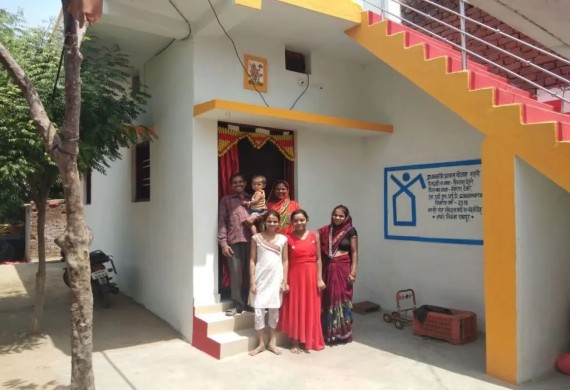

Women in rural areas own more than 69% of the homes built under the Prime Minister's Special Housing Scheme, either solely or jointly.
Out of the 2.46 crore residences that were approved, two crore have been built as of September 29, 2022, according to data provided by the government. 69% of these are wholly or partially owned by women.
In order to build 2.95 crore homes, the Prime Minister introduced the Pradhan Mantri Awas Yojana (Gramin) in 2016.
According to a top official in the Ministry of Women and Child Development, the Nari Shakti initiative was designed to ensure that women receive a fair share of government benefits.
Instead of "development of women," the initiative's central tenet is "women-led" development.
"By providing homes under the PMAY-G, the government has improved women's participation in household financial decision-making and met their goal to possess a pucca house. Living in a pucca house with minimal facilities boosts their social inclusion and provides security, dignity, and economic power.
The government claims that the Pradhan Mantri Ujjwala Yojana's provision of clean cooking fuel has contributed to safeguarding the health of women and children.
The Ujjwala Yojana has provided over 9.4 crore LPG connections.
This programme has garnered international acclaim from the International Energy Agency, which hailed it as a significant accomplishment in enhancing women's health and the environment.
The Swachh Bharat Mission, which saw the construction of 70 lakh toilets in urban areas and 11.5 crore in rural areas, is another programme that has assisted women in gaining dignity and security.
The government cited a study titled "Access to toilets and the safety, convenience, and self-respect of women in rural India" to support its claim that after toilets were built, 93% of women said they were no longer afraid of being hurt by people or animals while defecating; 93% of women said they are no longer afraid of contracting health infections; and 92% of women said they were no longer afraid of using the restroom alone at night.
Current Issue

Most Viewed
- 1 Talented Indian Female Actors Who Also Moonlight as Successful Producers
- 2 7 Indian Female Podcasters You Must Know About
- 3 7 Powerful Independent Indian Women Journalists Who are Voices of Change
- 4 Ruchikaa Kapoor Sheikh: The Creative Mind Behind Netflix India's Popular Shows
- 5 7 Most Influential Women Educators India has had over the Years
- 6 11 Breakthrough Female Faces Ruling the Indian OTT Platforms
- 7 8 Timeless Female Indian Classical Dancers & their Legacy
- 8 Women's Health Startup HerMD Closing Doors Amid Industry Challenges
- 9 Real Meets Reel: A List of 11 Indian Movies based on Real Women
- 10 Rasha Hassan: A Visionary Leader On A Mission To Transform Dubai's Real Estate Landscape
- 11 5 Indian Women-led IPOs You Must Know About
- 12 11 of the Most Iconic 21st Century Women to become "The First Indian Woman"
- 13 India's 7 Funniest Women Stand-Up Comics You Must Follow
- 14 Aparna Purohit : Leading India's Most Popular OTT Platforms
- 15 How Leaders Can Balance Risk & Innovation in Today's Banking Landscape
- 16 Dr. K. Shilpi Reddy: Sculpting Healthier Futures For The Next Generation With Reforms In Obstetrics Care
- 17 Sylvia Dcosta: A Visionary Business Leader Pushing The Limits And Setting High Professional Standards
- 18 Top 5 All-Rounder Women Cricketers of India
- 19 How Tata AIA is Empowering Women with Insurance That Understands Their Needs


