
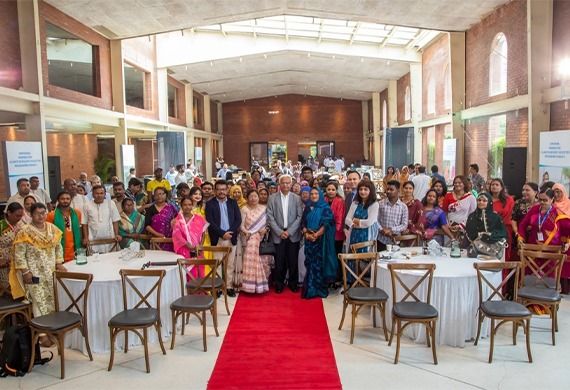

The Bangladesh government, along with development partners, civil society organizations, financial institutions, academics, women climate champions and UN agencies, participated in the National Lessons Learned and Scale-Up Workshop at Aloki in Dhaka to reflect on the progress of the EmPower: Women for Climate-Resilient Societies Phase II program and explore potential expansion of women-led climate action programs across Bangladesh.
The workshop was organized with the support of the governments of Sweden, Switzerland, Germany and New Zealand and emphasized the positive effect of the regional EmPower initiative being undertaken in Bangladesh, Cambodia and Vietnam by UN Women and the United Nations Environment Program (UNEP). The program targets enhancing women's leadership role in climate resilience, renewable energy, access to finance and locally led adaptation.
In Bangladesh, the program has been rolled out in five climate vulnerable districts (Khulna, Satkhira, Jamalpur, Kurigram and Cox's Bazar) with an impact of 10 upazilas. EmPower data presented at the workshop indicates that the project has reached over 33,284 women and affected 1.6 million people—of which 1.1 million are women—with climate-resilient livelihoods and services. The program has also helped mobilize $3 million for 308 women-led renewable energy businesses, and helped the Government of Bangladesh to take the Climate Change Gender Action Plan forward into measurable and costed sectoral interventions.
Social Welfare and Women and Children Affairs Minister Professor Dr Abu Zafar Md Zahid Hossain, who served as the chief guest of the workshop, inaugurated it. Turning community experiences into mainstream national policies and investments is vital, he told the participants.
Key Highlights:
- EmPower reached 33,000+ women and benefited 1.6 million people in climate-vulnerable districts
- $3 million mobilized to support 308 women-led renewable energy businesses
- Stakeholders urged scaling up women-led climate action and gender-responsive climate finance nationwide
We need to provide women with education, skills and confidence to lead, to adapt to climate change and those who have the knowledge will survive and lead.
Emphasizing the success of the program, Gitanjali Singh from UN Women Bangladesh, stated that the program has proven to be effective in improving livelihoods, utilization of renewable energy and women's involvement in climate decision making.
The program shows evidence that commitments to climate action are meaningful when they directly benefit the lives of women and girls through finance, localization and tangible results, she added. Singh also called gender-responsive climate action practical and scalable as it is a smart investment for sustainable development.
During the workshop, challenges of women's leadership in climate adaptation, climate smart and renewable energy, and climate resilient livelihoods and community action were discussed. As part of the program, women climate champions from the program districts shared their experience as climate leaders and building resilience in their communities.
Farida Yasmin, chairperson of Nari Associate for Revival and Initiative in Kurigram, pointed out that the program had given women empowerment, knowledge, information and confidence to take part in the decision making process.
EmPower has been a collective leadership and resilience experience, where women in my community have developed skills and gained a voice at the table.
Several international development partners also attended the event, including Diepak Elmer, Head of Cooperation at Embassy of Switzerland; Redita Rokib, Advisor for Development Cooperation at German Embassy in Dhaka; Nayoka Martinez-Bäckström, First Secretary and Deputy Head of Development Cooperation at Embassy of Sweden and Md Saidur Rahman Khan, Secretary of Ministry of Disaster Management and Relief. Dr Nurun Nahar, Additional Secretary, Development Wing at the Ministry of Environment, Forest and Climate Change, was the guest of honour at the event.
Participants highlighted the importance of enhancing cooperation among the government, financial institutions, development partners, and civil society organizations to scale-up women-led climate solutions and develop gender-sensitive climate finance and policy.
The strength of the EmPower program is its comprehensive approach, where grassroots innovation is linked to national policy discourses and where it interacts closely with women's community networks, Martinez-Bäckström said. The initiative has also helped build the capacity of local civil society organizations to take up new opportunities as the country moves towards becoming a middle income country, she added.
In the workshop, the official launch of the EmPower Bangladesh webpage was made, which now has public access and shares the program results, knowledge resources and learning materials. A photo exhibition of the stories and photographs collected by members of the Women in Climate Action Network was also opened, which features women-led adaptation efforts from climate vulnerable communities.
The contribution of the project partners, the Bangladesh Centre for Communication Programs, Manusher Jonno Foundation and BRAC University CED, were recognized in the implementation of the program.
Current Issue

Most Viewed
- 1 Talented Indian Female Actors Who Also Moonlight as Successful Producers
- 2 7 Indian Female Podcasters You Must Know About
- 3 7 Powerful Independent Indian Women Journalists Who are Voices of Change
- 4 Ruchikaa Kapoor Sheikh: The Creative Mind Behind Netflix India's Popular Shows
- 5 7 Most Influential Women Educators India has had over the Years
- 6 11 Breakthrough Female Faces Ruling the Indian OTT Platforms
- 7 8 Timeless Female Indian Classical Dancers & their Legacy
- 8 Women's Health Startup HerMD Closing Doors Amid Industry Challenges
- 9 Real Meets Reel: A List of 11 Indian Movies based on Real Women
- 10 Rasha Hassan: A Visionary Leader On A Mission To Transform Dubai's Real Estate Landscape
- 11 5 Indian Women-led IPOs You Must Know About
- 12 11 of the Most Iconic 21st Century Women to become "The First Indian Woman"
- 13 India's 7 Funniest Women Stand-Up Comics You Must Follow
- 14 Aparna Purohit : Leading India's Most Popular OTT Platforms
- 15 How Leaders Can Balance Risk & Innovation in Today's Banking Landscape
- 16 Dr. K. Shilpi Reddy: Sculpting Healthier Futures For The Next Generation With Reforms In Obstetrics Care
- 17 Sylvia Dcosta: A Visionary Business Leader Pushing The Limits And Setting High Professional Standards
- 18 Top 5 All-Rounder Women Cricketers of India
- 19 How Tata AIA is Empowering Women with Insurance That Understands Their Needs


