
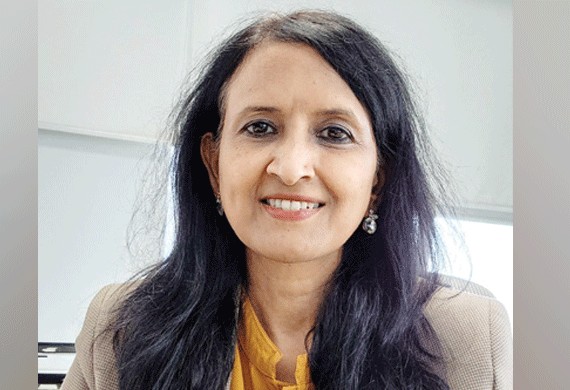

A Thinkers360 thought leader and disruptive thinker for advancing the strategic direction of the business through innovation and organizational leadership. She challenges the status quo, has a high risk appetite, and believes in continuous learning. Geetha works effectively as a Cross-Functional Change Agent, spearheading data driven decision making, fostering a culture of experimentation, client-centricity, innovation and value creation.
This article aims to provide an overview of the status of women empowerment in India and take stock of the issues that tend to stymie the progress and explore potential approaches that could help alleviate the problem. I would like to start by looking at the basics. When you look at the percentage of women in India and the representation of women in workforce the finding is depressing. While women constitute 48 percent of India’s population, only 18 percent are actively engaged in the organized workforce.
It tells a stark story of societal suppression, patriarchal mindset - which has been deep rooted over generations, orchestrated denial of education and employment opportunities for women, a highly skewed gender ratio when it comes to workforce composition, and a discriminatory approach whether it is rural or urban in enabling women’s participation. Women suffer from discrimination when it comes to education, economic opportunities to generate income and own assets, health and medical assistance, and authority to take decisions.
What is Empowerment
Empowerment has different definitions but the one that appealed to me most is – it is the process of becoming stronger and more confident, especially in controlling one's life and claiming one's rights. As simple as this may seem, not everyone is fortunate to be empowered and feel empowered. Especially, addressing the challenge of empowering women is a massive and complex issue.
Factors that Impact
It is in this context that women empowerment assumes great significance in India which is the most populous democracy in the world. In my view, empowerment is broadly impacted by three sets of factors, or pillars, ie; Social, Educational and Economic. And the lines tend to blur across the three pillars.
Social
From a societal perspective, families ought to be educated about the biased approach they may be taking, especially in those families where they strongly believe that a woman’s place is inside the home and homemaking alone is her primary and sole responsibility. In some ways such families think women are subservient to the men in the family, and any form of progress on the educational or employment front is treated with scorn, disapproval, and retribution.
Further, the worst kind of challenges is faced by women mostly in the lower income groups where their poorly educated and regressive minded spouses and kin take it as their willful right. To unleash violence on the, and in many cases, quite shockingly take pride in talking about how they terrorize these women, to keep them under their ‘control’.
Such a discriminatory mindset nurtured carefully over generations also drives them to exclude girls from education and learning opportunities, thereby depriving them of self-confidence, and leading to lower self-esteem. Another unflattering revelation is women are more represented in the ‘unorganized sector’ where the skills required are less nuanced and the laws of labor less fair and equitable.
"Education and literacy form the foundation on which other aspects of socio-economic inclusion and empowerment take shape"
There is also the issue of women empowerment being less visible in rural India than in urban settings. Women in urban areas have relatively better access to education, employment, healthcare, and decision-making, though they remain under-represented in the workforce.
Educational
Education and literacy form the foundation on which other aspects of socio-economic inclusion and empowerment take shape. Educating men about this need is the key so they can become true allies and supporters of women in their families to help them become employable in the organized sector. When access to education is ensured, and equal opportunities are made available to women for learning and capability development, and employment in different sectors, or when they are supported financially to become entrepreneurs, that would help take women closer towards empowerment.
Economic
Finally, women should be ‘included’ and be given the authority to take decisions. Unconscious and conscious biases ought to be identified, called out and removed. A more inclusive and empathetic society will pave the way for a more inclusive workforce. When the wider ecosystem starts to transform into one that truly believes, values the need for women empowerment, and works towards making it a reality, the economy will start to see a paradigm shift cutting across social strata and generational segments. The role of private sector in partnership with Government bodies, educational institutions, civic society, NGOs, and public sector in providing an enabling framework, driving awareness, building the support system and being change agents to increase women empowerment will be crucial.
Conclusion
India’s journey in women empowerment and gender equality has been a long one and while visible gains have been made through legal reforms, human development, and grassroots initiatives, as a society we still have a long way to go.
In urban areas, Inclusion, Diversity and Equity need a larger focus than ever before to see a paradigm shift in representation of women across industries, professions, and hierarchies. A more concerted effort is needed to close the urban-rural divide and ensure that women in rural areas enjoy the same access to education, employment, healthcare, and decision-making as their urban counterparts.
The hardest challenge will be to change attitudes, given that many barriers to women empowerment are attributed to patriarchal and patrilineal traditions that are deeply entrenched in the society. As a collective society we can and must do our bit to improve women empowerment for the benefit of humanity, economy, and society at large and needless to add every bit matters.
Current Issue
Most Viewed
- 1 Talented Indian Female Actors Who Also Moonlight as Successful Producers
- 2 7 Indian Female Podcasters You Must Know About
- 3 7 Powerful Independent Indian Women Journalists Who are Voices of Change
- 4 Ruchikaa Kapoor Sheikh: The Creative Mind Behind Netflix India's Popular Shows
- 5 7 Most Influential Women Educators India has had over the Years
- 6 11 Breakthrough Female Faces Ruling the Indian OTT Platforms
- 7 8 Timeless Female Indian Classical Dancers & their Legacy
- 8 Women's Health Startup HerMD Closing Doors Amid Industry Challenges
- 9 Real Meets Reel: A List of 11 Indian Movies based on Real Women
- 10 Rasha Hassan: A Visionary Leader On A Mission To Transform Dubai's Real Estate Landscape
- 11 5 Indian Women-led IPOs You Must Know About
- 12 11 of the Most Iconic 21st Century Women to become "The First Indian Woman"
- 13 India's 7 Funniest Women Stand-Up Comics You Must Follow
- 14 Aparna Purohit : Leading India's Most Popular OTT Platforms
- 15 How Leaders Can Balance Risk & Innovation in Today's Banking Landscape
- 16 Dr. K. Shilpi Reddy: Sculpting Healthier Futures For The Next Generation With Reforms In Obstetrics Care
- 17 Sylvia Dcosta: A Visionary Business Leader Pushing The Limits And Setting High Professional Standards
- 18 Top 5 All-Rounder Women Cricketers of India
- 19 How Tata AIA is Empowering Women with Insurance That Understands Their Needs


