
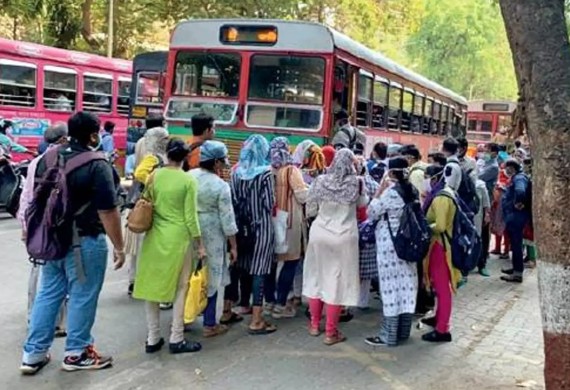

Last week Tamil Nadu CM, M K Stalin announced free bus travel for women across the state. The initiative was launched not only to boost ridership but also bring about increased participation of women in the workforce. While the free travel facility for women will cost the state exchequer Rs.1200 crore in the annual revenue of the state transport corporations, yet the move is slated to bring about long term benefits with more women contributing in the workforce.
It is pertinent to note that Tamil Nadu has one of the lowest percentage of working women population.
The state was the third to do so after Punjab and Delhi. Last month Punjab CM, Amarinder Singhannouncement the state government’s initiative for free-of-cost travel for women in all government buses. This initiative is expected to benefit more than 1.31 crore women/girls across the state. The first however to launch such an initiative was Delhi. Arvind Kejriwal had announced the launch of the scheme ahead of the last Delhi Elections.
While on the surface it might seem like a populous move on part of the state governments, yet such schemes that boost access to mobility for women and can have a huge impact on the opportunities provided to them in the long run.
Women who constitute almost 48 percent of India’s population form a small part of India’s workforce. According to data collated by the World Bank, in 1990, the female labour force participation rate (FLFPR) in the country was 30.27% in 1990. Surprisingly, the percentage fell to a measly 20.8 percent in 2019. The 2011 census data also concluded that working women contribute only to 31.8% of the work participation rate while men account for 59.3% of the work participation rate. Needless to say, the economy stands to benefit greatly with an increase in the work participation rate of women.
Although a plethora of factors play a role in hindering women from participating in the workforce, yet transportation plays a key role. An Informal Economy Monitoring Survey observed that factors such as long distances acted as major deterrents for women’s participation in the workforce. It was seen that women in urban areas are more likely to reject better-paying jobs that are far away from their homes for lower-paid, local opportunities. A major reason for this phenomenon was discovered to be related to public transport. Other than safety and security, the affordability of public transport was a key concern. Thus, the move to make public transport free for all women can surely act as a motivating factor to get more women out in the labour force.
Contrary to popular belief, mobility is not gender neutral and largely benefits men. Since money earning roles are prioritized over caregiving and housekeeping, thus usage of private vehicles is much higher in men than in women. This leaves two options, public transport and shared rides through cabs or auto-rickshaws. On account of safety, frequency, affordability, and feasibility, less number of women opt for shared vehicles. This leaves them with public transport system of which local buses form a large part.
Making travel more accessible and affordable for women will not only promote safety of women but will also facilitate other needs such as availing higher education. It can act as a stepping stone towards more women contribute economically which would in turn uplift their socio-economic status in the society. Access to transport also ensures women’s effective participation and equal opportunities for leadership in political, economic, and public life. It also helps them gain more agency in life.
Current Issue
Most Viewed
- 1 Talented Indian Female Actors Who Also Moonlight as Successful Producers
- 2 7 Indian Female Podcasters You Must Know About
- 3 7 Powerful Independent Indian Women Journalists Who are Voices of Change
- 4 Ruchikaa Kapoor Sheikh: The Creative Mind Behind Netflix India's Popular Shows
- 5 7 Most Influential Women Educators India has had over the Years
- 6 11 Breakthrough Female Faces Ruling the Indian OTT Platforms
- 7 8 Timeless Female Indian Classical Dancers & their Legacy
- 8 Women's Health Startup HerMD Closing Doors Amid Industry Challenges
- 9 Real Meets Reel: A List of 11 Indian Movies based on Real Women
- 10 Rasha Hassan: A Visionary Leader On A Mission To Transform Dubai's Real Estate Landscape
- 11 5 Indian Women-led IPOs You Must Know About
- 12 11 of the Most Iconic 21st Century Women to become "The First Indian Woman"
- 13 India's 7 Funniest Women Stand-Up Comics You Must Follow
- 14 Aparna Purohit : Leading India's Most Popular OTT Platforms
- 15 How Leaders Can Balance Risk & Innovation in Today's Banking Landscape
- 16 Dr. K. Shilpi Reddy: Sculpting Healthier Futures For The Next Generation With Reforms In Obstetrics Care
- 17 Sylvia Dcosta: A Visionary Business Leader Pushing The Limits And Setting High Professional Standards
- 18 Top 5 All-Rounder Women Cricketers of India
- 19 How Tata AIA is Empowering Women with Insurance That Understands Their Needs


