Leaders

Across India’s rapidly evolving startup ecosystem, women entrepreneurs are emerging as powerful changemakers in the field of assistive technology for visual impairment. By blending empathy with innovation, these leaders are designing solutions that go beyond basic assistance, enabling independence, dignity, and inclusion for millions.
Their work is not just about technology; it is about reshaping everyday experiences for the visually impaired through intelligent, accessible, and affordable tools. From AI-driven navigation systems to smart reading devices, women-led startups are redefining how technology can bridge accessibility gaps and create meaningful social impact. Among these inspiring leaders is Kanika Sharma, Founder of Smart Eye, whose journey reflects both resilience and purpose-driven innovation.
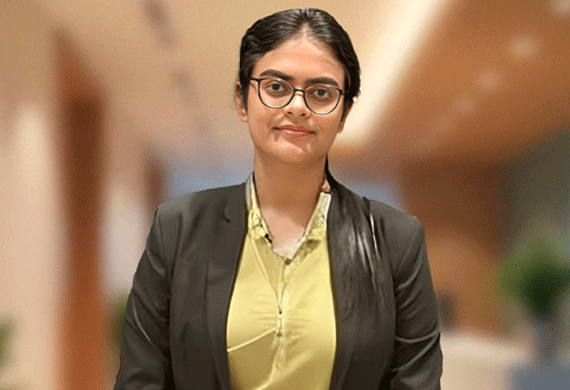
Kanika Sharma, a curious and academically driven individual from South Delhi, studied at Carmel Convent School and earned recognition in CBSE Mathematics. Despite setbacks during the Class 11 lockdown, she pursued a B.Tech in Computer Science from BML Munjal University. Her entrepreneurial journey began in 2022 with Smart Eye as a college project, which soon evolved into a mission-driven venture. Through research and user interactions, she developed a deep understanding of challenges faced by the visually impaired, inspiring her to build impactful, independence-enabling assistive solutions.
Tell us about your professional experience within the industry. What expertise do you bring to the table?
My expertise primarily lies in Computer Science, especially in AI and Machine Learning. At Smart Eye, I handle business development and financial operations, while also contributing significantly to the software side, including coding and AI model integration.
My work revolves around developing solutions at the intersection of technology and social impact. I am involved in training AI models, handling datasets, conducting real-world testing, and ensuring user-centric design. I also oversee surveys, pilot testing, and ensuring that our solutions align with actual user needs. My co-founder focuses on hardware, while I lead the AI and software integration aspects of our products.
What inspired you to found Smart Eye? What is the underlying idea and vision behind the venture?
Smart Eye was born out of empathy and real-world understanding. While it started as a college project, interacting with visually impaired individuals during research and surveys made me realize how challenging everyday life can be without sight.
This inspired me to build something that not only assists but truly empowers users. The vision behind Smart Eye is to create inclusive technology that enables people with disabilities to navigate, learn, and live independently with dignity. For me, Smart Eye is not just a startup, it is a mission to bridge the gap between technology and accessibility on a global scale.
Tell us about Smart Eye’s products, BlindStick and PathPal. What was the core idea behind designing these products and what unique advantages do they bring?
Our flagship product is PathPal, an AI-enabled assistive device designed as an “all-in-one smart eyes” for visually impaired users. It assists in navigation, mobility, and literacy, addressing everyday challenges comprehensively.
PathPal can detect obstacles from head to ground level, preventing injuries. It also reads printed text aloud from books, laptops, billboards, and more, in multiple languages. Additionally, it can recognize currency denominations and even handwriting.
What makes PathPal unique is that it is an offline, edge-based system combining multilingual OCR, obstacle detection, and audio-vibration feedback in a compact, ergonomic, and affordable device. With a detection accuracy of around 94 percent,, it stands out in reliability and accessibility. Compared to existing products priced between ₹20,000–₹80,000, PathPal is available at approximately ₹10,000, making it far more affordable.
BlindStick was an earlier prototype with limited functionality, which has now been replaced by the more advanced PathPal.
How has Smart Eye’s growth and impact journey been so far? What is your long-term vision?
Our journey has been highly impactful. We have reached over 600 visually impaired users across India through pilot programs. We have partnered with organizations such as the National Association for the Blind (Delhi and Himachal Pradesh), Blind Relief Association (New Delhi), HPICSA, Equibeing Foundation (Bangalore), and NTPC.
Our pilots have shown significant improvements in users’ mobility, literacy, confidence, and independence. PathPal has enabled users to perform everyday tasks without relying on others.
For me, Smart Eye is not just a startup, it is a mission to bridge the gap between technology and accessibility on a global scale
A major milestone was receiving an international order from Singapore, which led to our official incorporation in May 2024. Looking ahead, our vision is to scale globally and continue to create meaningful social impact.
Can you highlight your key achievements in the field of sports? What role has sports played in your life?
Sports have played a crucial role in shaping my personality. I have been practicing Taekwondo since Class 4 and hold a black belt. I have also actively participated in swimming, badminton, basketball, table tennis, and chess.
Sports have instilled discipline, resilience, mental strength, and the ability to handle both success and failure. These qualities have been instrumental in my entrepreneurial journey, especially in dealing with challenges and high-pressure situations.
Looking back at your journey, what key milestones stand out? What is your guiding success mantra?
Some of the key milestones include exporting our prototype internationally to Singapore, winning competitions like the Hult Prize and AICTE IDE Bootcamp, being featured in the AI Impact Summit and publications in various news and media platforms focusing on our technology for social good.
We have also received government grants, CSR funding from American Express, and incubation support from IIT Mandi Catalyst, NSRCEL, IIM Bangalore and AMTZ.
My success mantra is to stay consistent, focus on impact rather than noise, and approach challenges with positivity and resilience. I strongly believe in fostering a collaborative and respectful work culture, where every team member feels valued and heard.
Kanika Sharma, Founder, Smart Eye
Kanika Sharma is the Founder of Smart Eye, an assistive technology startup focused on empowering the visually impaired. A Computer Science graduate from BML Munjal University, she combines AI expertise with social impact innovation. Her journey from a college project to a purpose-driven venture reflects her commitment to accessibility and inclusive technology.
Current Issue
Most Viewed
- 1 Talented Indian Female Actors Who Also Moonlight as Successful Producers
- 2 7 Indian Female Podcasters You Must Know About
- 3 7 Powerful Independent Indian Women Journalists Who are Voices of Change
- 4 Ruchikaa Kapoor Sheikh: The Creative Mind Behind Netflix India's Popular Shows
- 5 7 Most Influential Women Educators India has had over the Years
- 6 11 Breakthrough Female Faces Ruling the Indian OTT Platforms
- 7 8 Timeless Female Indian Classical Dancers & their Legacy
- 8 Women's Health Startup HerMD Closing Doors Amid Industry Challenges
- 9 Real Meets Reel: A List of 11 Indian Movies based on Real Women
- 10 Rasha Hassan: A Visionary Leader On A Mission To Transform Dubai's Real Estate Landscape
- 11 5 Indian Women-led IPOs You Must Know About
- 12 11 of the Most Iconic 21st Century Women to become "The First Indian Woman"
- 13 India's 7 Funniest Women Stand-Up Comics You Must Follow
- 14 Aparna Purohit : Leading India's Most Popular OTT Platforms
- 15 How Leaders Can Balance Risk & Innovation in Today's Banking Landscape
- 16 Dr. K. Shilpi Reddy: Sculpting Healthier Futures For The Next Generation With Reforms In Obstetrics Care
- 17 Sylvia Dcosta: A Visionary Business Leader Pushing The Limits And Setting High Professional Standards
- 18 Top 5 All-Rounder Women Cricketers of India
- 19 How Tata AIA is Empowering Women with Insurance That Understands Their Needs


