

- Malnutrition and Anaemia continue to smear India's HDI ranking
- Parliamentary committee desires beyond inter-departmental coordinated action
- A "National Mission" has been proposed for eradicating malnutrition and Anaemia by 2032
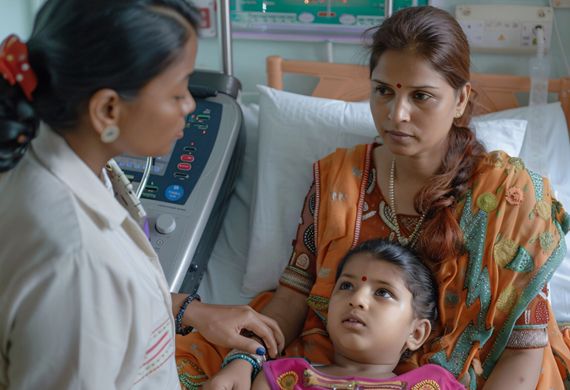
A parliamentary committee, revealing a report on Friday, noted that the poor performance of India with regard to malnutrition and Anaemia of children under five years of age and pregnant or lactating mothers is adversely affecting India's position on the global Human Development Index. The committee called for the coordinated efforts of various departments and mooted a ‘National Mission’ for the eradication of the maladies by 2032.
The committee on education, women, children, youth, and sports of the department related to Congress MP Digvijaya Singh had noted that the National Family Health Survey (2015-16) recorded the percentage of stunted children at 38.4 percent, as it later dropped to 35.5 percent in the 2019-21 NFHS. In fact, according to the Poshan Tracker data from the Ministry of Women and Child Development for January 2025, stunting-increased to 39.6 percent among children 0-5 years.
In this respect, the committee recommended that a "national breakfast program" be initiated to counter morning hunger and to provide scientific cognitive development of children, especially those in rural under-privileged areas.
It was emphasized by the committee that the Ministry of Women and Child Development (WCD) would be at the forefront in creating a "National Mission" for malnutrition and anaemia eradication, which would then lead to the participation of different ministries such as women and child development, health, education and finance.
As at December 2024, the number of children from 0-6 years enrolled in anganwadis and connected to the Poshan Tracker was 8.82 crores, whereas more than 10 crores, including children, lactating mothers, pregnancy, and adolescent girls, have been registered as beneficiaries as of January 30, 2025. The committee suggested that the Ministry coordinate proactively with state governments to be able to register the more than seven crore children who are currently outside anganwadi centres.
The committee also noted that the critical period for fighting malnutrition and stimulating brain development is in the first 1,000 days of life, including time spent in the womb. But under the current system, they provide institutional child care only for 3-6 years of age for a few hours each day in anganwadis; below that, children from 6 months to 3 years only receive take-home rations.
It fully supports this with the position of the Law Commission, which said "every child under six should have an unconditional right to crèche and day-care services provided by the state." This would mean that all anganwadis would be converted into full-day crèches, which means they will operate at least 10 hours a day for children aged 6 months to 3 years. The plan would support working women and their children, with the provision of a morning snack, a hot cooked lunch, and an evening snack similar to the existing Palna scheme. Finally, an extra anganwadi worker was recommended for the children aged 6 months to 3 years who would be using these daycare facilities.
Current Issue
Most Viewed
- 1 Talented Indian Female Actors Who Also Moonlight as Successful Producers
- 2 7 Indian Female Podcasters You Must Know About
- 3 7 Powerful Independent Indian Women Journalists Who are Voices of Change
- 4 Ruchikaa Kapoor Sheikh: The Creative Mind Behind Netflix India's Popular Shows
- 5 7 Most Influential Women Educators India has had over the Years
- 6 11 Breakthrough Female Faces Ruling the Indian OTT Platforms
- 7 8 Timeless Female Indian Classical Dancers & their Legacy
- 8 Women's Health Startup HerMD Closing Doors Amid Industry Challenges
- 9 Real Meets Reel: A List of 11 Indian Movies based on Real Women
- 10 Rasha Hassan: A Visionary Leader On A Mission To Transform Dubai's Real Estate Landscape
- 11 5 Indian Women-led IPOs You Must Know About
- 12 11 of the Most Iconic 21st Century Women to become "The First Indian Woman"
- 13 India's 7 Funniest Women Stand-Up Comics You Must Follow
- 14 Aparna Purohit : Leading India's Most Popular OTT Platforms
- 15 How Leaders Can Balance Risk & Innovation in Today's Banking Landscape
- 16 Dr. K. Shilpi Reddy: Sculpting Healthier Futures For The Next Generation With Reforms In Obstetrics Care
- 17 Sylvia Dcosta: A Visionary Business Leader Pushing The Limits And Setting High Professional Standards
- 18 Top 5 All-Rounder Women Cricketers of India
- 19 How Tata AIA is Empowering Women with Insurance That Understands Their Needs


