
Leaders
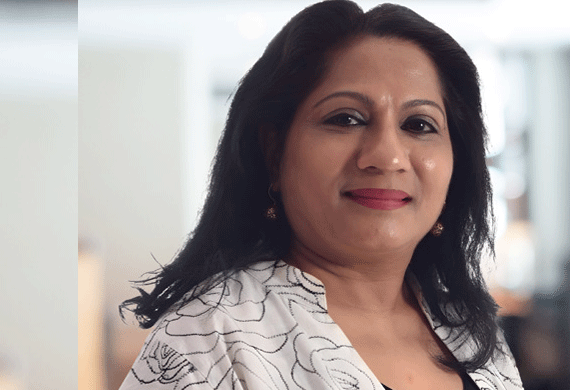


For Girija Krishan Varma, leadership was not learned in boardrooms but absorbed in her early years, where integrity, inclusion, and empathy were everyday practice. Growing up in a household shaped by resilience and quiet generosity, she witnessed how strength could coexist with compassion. Whenever faced with adversity, her parents without becoming hardened by it, choose to remain open-hearted and deeply fair, especially toward those with fewer advantages. These formative experiences instilled in her a lasting belief that character is the true foundation of authority.
Her father’s tireless dedication to research and scholarly writing, paired with her mother’s wisdom and moral clarity, offered early lessons in discipline, thoughtful decision making, and accountability. From them, Girija learned that leadership is not defined by privilege or power, but by fairness, inclusion, and the responsibility to ensure that decisions do not disproportionately impact those with less agency.
Today, as an Independent Director, these values anchor her approach to governance and strategy. Known for her ethical clarity and independent judgment, she brings a long term, stewardship-driven perspective to the boardroom, one that balances accountability with empathy and reinforces trust at the highest levels of corporate leadership.
Tell us about your extensive professional journey, highlighting key turning points?
My professional journey has been shaped by earning every step forward. I began as a first-generation woman lawyer, and early on, I realised that credibility had to come from competence and consistency. I chose to invest deeply in my craft by building substantive expertise, holding myself to exacting professional standards while refining my legal reasoning, strategic insight, and decision-making abilities.
I chose to invest in continuous learning & training, that included advanced education at Cornell and Stanford, and British Council Chevening Scholarship which broadened my perspective and grounded me in global standards of governance, risk management, and ethical leadership.
I gathered extensive practical experience and international exposure at work with leading law firms, multinational corporations, and complex cross-border matters, giving me firsthand insight into how institutions function under pressure and how governance strengths or failures shape outcomes.
Key turning points came when I moved into roles requiring independent judgment as an arbitrator, mediator, and strategic advisor. Today, as an Independent Director, I bring this global exposure and practical experience to board deliberations, with a strong governance lens and a long-term focus on accountability and value creation.
How do you contribute to strengthening the company’s governance and long-term strategy as an Independent Director?
As a woman leader, my formative experiences inform my approach to governance and strategy through a DEI lens. I am attentive to how systems, policies, and decisions affect different stakeholders, especially those who may not be at the table. I believe diversity strengthens decision-making, inclusion builds trust, and equity ensures sustainability. These principles guide how I lead, advise, and contribute at the board and institutional levels.
What unique challenges do you navigate in your role?
Every leadership role brings distinct challenges, and as an Independent Director, the most enduring one is preserving true independence while engaging constructively with management and stakeholders. It requires balancing oversight with support, and asking difficult questions without becoming adversarial.
My background as a lawyer, arbitrator, and mediator has trained me to navigate complexity and competing interests with objectivity. I address these challenges by insisting on clear processes, sound documentation, and reasoned decision making, cornerstones of transparency and accountability.
Integrity is non-negotiable for me. I am guided by strong ethical frameworks, strict conflict-of-interest discipline, and a deep respect for fiduciary duties. Transparency comes from open dialogue, accurate reporting, and the willingness to record dissent when required.
This approach enables real value creation, helping boards make better strategic decisions, manage risk effectively, and build resilient, sustainable institutions over the long term.
Looking back, what professional achievements are you most proud of? What is your success mantra?
Looking back, what stands out in my journey is not a single achievement, but the consistency and range of responsibility I have been entrusted with over time. As a first-generation lawyer and a woman in a male-dominated profession, building and sustaining credibility across decades has itself been a meaningful milestone.
I value the trust placed in me to handle complex, high stakes matters, advising multinational corporations, serving as an arbitrator and mediator in domestic and international disputes, and contributing to institution-building through governance and education. Moving between advocacy, adjudication, and strategic advisory roles has shaped my ability to view issues holistically and exercise balanced judgment.
For me, success lies in influencing outcomes with lasting impact, whether through landmark judgments, reasoned arbitral awards, or resolving long-pending disputes. My mantra is simple: prepare deeply, act with integrity, and remain independent in thought, always taking the long-term view.
Prepare deeply, act with integrity, and remain independent in thought, always taking the long-term view
How do you foresee the future of corporate governance in India evolving?
I see the future of corporate governance in India moving beyond a compliance-driven approach to one that is purpose led and stakeholder-focused. Boards will be expected to look past short-term financial metrics and take responsibility for long-term value creation, ethical conduct, and institutional trust.
Stakeholder governance will play a central role, with employee interests, customer trust, regulatory expectations, and societal impact shaping decisions.
Digital transformation will also redefine the boardroom. Directors must engage with cybersecurity, data governance, artificial intelligence, and technology risk. I also see growing emphasis on diversity of thought and experience, not just representation. The boardroom of the future will be defined by independence, transparency, continuous learning, and a clear commitment to sustainable, responsible growth.
Girija Krishan Varma, Independent Director, Ccavenue
Girija Krishan Varma is an Independent Director, certified mediator, Fellow arbitrator, and a distinguished ADR expert with deep experience in corporate governance, legal strategy, family disputes and intellectual property. A first-generation lawyer, she has advised multinational corporations and served in high-stakes domestic and international disputes with objectivity and ethical clarity. She holds an LL.M from Cornell University, is a Fellow of Stanford Law School, and a British Council Chevening Scholar. Known for her independent judgment and long-term perspective, she brings rigor, integrity, and a strong stewardship mindset to the boardroom.
Current Issue
Most Viewed
- 1 Talented Indian Female Actors Who Also Moonlight as Successful Producers
- 2 7 Indian Female Podcasters You Must Know About
- 3 7 Powerful Independent Indian Women Journalists Who are Voices of Change
- 4 Ruchikaa Kapoor Sheikh: The Creative Mind Behind Netflix India's Popular Shows
- 5 7 Most Influential Women Educators India has had over the Years
- 6 11 Breakthrough Female Faces Ruling the Indian OTT Platforms
- 7 8 Timeless Female Indian Classical Dancers & their Legacy
- 8 Women's Health Startup HerMD Closing Doors Amid Industry Challenges
- 9 Real Meets Reel: A List of 11 Indian Movies based on Real Women
- 10 Rasha Hassan: A Visionary Leader On A Mission To Transform Dubai's Real Estate Landscape
- 11 5 Indian Women-led IPOs You Must Know About
- 12 11 of the Most Iconic 21st Century Women to become "The First Indian Woman"
- 13 India's 7 Funniest Women Stand-Up Comics You Must Follow
- 14 Aparna Purohit : Leading India's Most Popular OTT Platforms
- 15 How Leaders Can Balance Risk & Innovation in Today's Banking Landscape
- 16 Dr. K. Shilpi Reddy: Sculpting Healthier Futures For The Next Generation With Reforms In Obstetrics Care
- 17 Sylvia Dcosta: A Visionary Business Leader Pushing The Limits And Setting High Professional Standards
- 18 Top 5 All-Rounder Women Cricketers of India
- 19 How Tata AIA is Empowering Women with Insurance That Understands Their Needs


