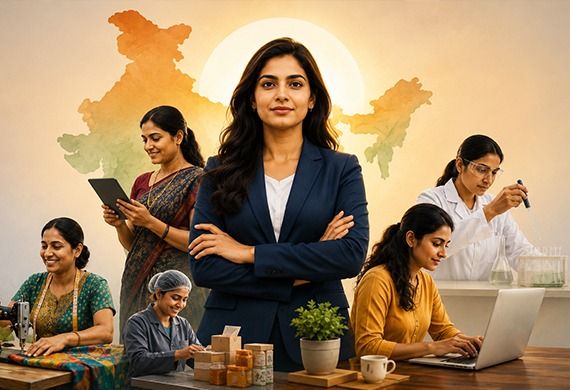

Key Challenges Holding Back Women Entrepreneurs in India
Despite significant progress, women entrepreneurs in India continue to face structural and systemic barriers that can limit their ability to start, formalise and scale businesses. Key challenges include:
-
Funding and Access to Capital
 Access to capital remains one of the most persistent challenges for women-led startups. Women-led businesses continue to receive a disproportionately smaller share of venture capital compared with their male-led counterparts.
The challenge extends beyond the availability of funds. Investor networks, mentorship, pitching opportunities, and representation in investment decision-making can all influence which businesses receive funding. Closing the funding gap will require greater access to women-focused capital alongside stronger diversity within mainstream investment ecosystems.
-
Collateral and Credit Constraints
For women entrepreneurs outside the established startup ecosystem, institutional credit can remain difficult to access. Limited ownership of property and other forms of collateral can restrict borrowing capacity, particularly for women-led MSMEs seeking capital to expand.
Accessible, collateral-free credit and appropriately structured financing can therefore play an important role in helping women-owned micro and small enterprises achieve sustainable growth.
-
Limited Representation in Decision-Making
Greater participation in the workforce does not always translate into women’s representation in leadership and decision-making. An IFC report cited in the source material found that supervisory and machine-operation roles within some women-owned or women-staffed MSMEs remain predominantly male-dominated.
Women are often concentrated in lower-skilled and repetitive roles, including packaging and sorting. Creating pathways towards managerial, technical and leadership positions will be essential to ensuring that employment translates into greater economic agency.
-
Workforce Participation and Care Responsibilities
The broader challenge of female labour force participation also affects women’s entrepreneurial potential. Women outside the workforce may have fewer opportunities to develop professional networks, build skills, accumulate savings and identify entrepreneurial opportunities.
At the same time, unpaid domestic and caregiving responsibilities continue to disproportionately affect women. For aspiring founders, these responsibilities can limit the time, mobility and risk-taking capacity required to establish and scale a business.
-
The Formalisation Challenge
The concentration of women-owned enterprises in the informal sector remains a major barrier to business growth. Formal registration can provide access to institutional finance, government procurement, subsidies and structured business support.
Helping informal women-led enterprises transition into the formal economy could therefore unlock a significant pool of women’s entrepreneurial potential and create stronger pathways for sustainable business growth.
Current Issue
Most Viewed
- 1 Talented Indian Female Actors Who Also Moonlight as Successful Producers
- 2 7 Indian Female Podcasters You Must Know About
- 3 7 Powerful Independent Indian Women Journalists Who are Voices of Change
- 4 Ruchikaa Kapoor Sheikh: The Creative Mind Behind Netflix India's Popular Shows
- 5 7 Most Influential Women Educators India has had over the Years
- 6 11 Breakthrough Female Faces Ruling the Indian OTT Platforms
- 7 8 Timeless Female Indian Classical Dancers & their Legacy
- 8 Women's Health Startup HerMD Closing Doors Amid Industry Challenges
- 9 Real Meets Reel: A List of 11 Indian Movies based on Real Women
- 10 Rasha Hassan: A Visionary Leader On A Mission To Transform Dubai's Real Estate Landscape
- 11 5 Indian Women-led IPOs You Must Know About
- 12 11 of the Most Iconic 21st Century Women to become "The First Indian Woman"
- 13 India's 7 Funniest Women Stand-Up Comics You Must Follow
- 14 Aparna Purohit : Leading India's Most Popular OTT Platforms
- 15 How Leaders Can Balance Risk & Innovation in Today's Banking Landscape
- 16 Dr. K. Shilpi Reddy: Sculpting Healthier Futures For The Next Generation With Reforms In Obstetrics Care
- 17 Sylvia Dcosta: A Visionary Business Leader Pushing The Limits And Setting High Professional Standards
- 18 Top 5 All-Rounder Women Cricketers of India
- 19 How Tata AIA is Empowering Women with Insurance That Understands Their Needs